Car Battery Jumpstart Tools — Cables vs Jump Packs Compared
Jumper cables vs portable jump starter packs: NOCO Boost, GOOLOO, traditional cables. Safety, when each is best, and what to keep in your trunk.
Dead car batteries are among the most common roadside emergencies. Per AAA service call data, battery-related issues account for 40%+ of all service calls. The good news: modern portable jump starter packs have made dead battery situations resolvable in 5 minutes without needing another vehicle or roadside assistance.
This article uses Wirecutter testing, Consumer Reports evaluations, AAA battery care guidance, and Reddit community feedback to compare jumpstart tools. Topics include jumper cables vs jump packs, top brand recommendations, safety considerations, and proper storage.
For complementary content, see cordless car vacuum tested and windshield wiper replacement guide.
Why dead batteries happen
Common causes per Interstate Batteries data:
Lights left on: headlights, interior lights, even small accessory lights drain battery within hours.
Battery age: most car batteries last 3-5 years. Beyond that, capacity drops dramatically.
Cold weather: car batteries lose 30-50% capacity below 32°F. Borderline batteries fail in winter.
Short trips: alternator needs 30+ minutes of driving to fully recharge battery. Repeated short trips don’t fully charge.
Parasitic drain: alarm systems, computer modules, aftermarket electronics can slowly drain battery over weeks of non-use.
Internal failure: sulfation, plate damage, or cell failure prevents holding charge.
Battery problems are predictable — old battery + cold weather + short trips makes eventual failure much more likely. Preventive replacement at 4-5 years prevents most surprises.
Top recommendation: NOCO Boost Plus GB40
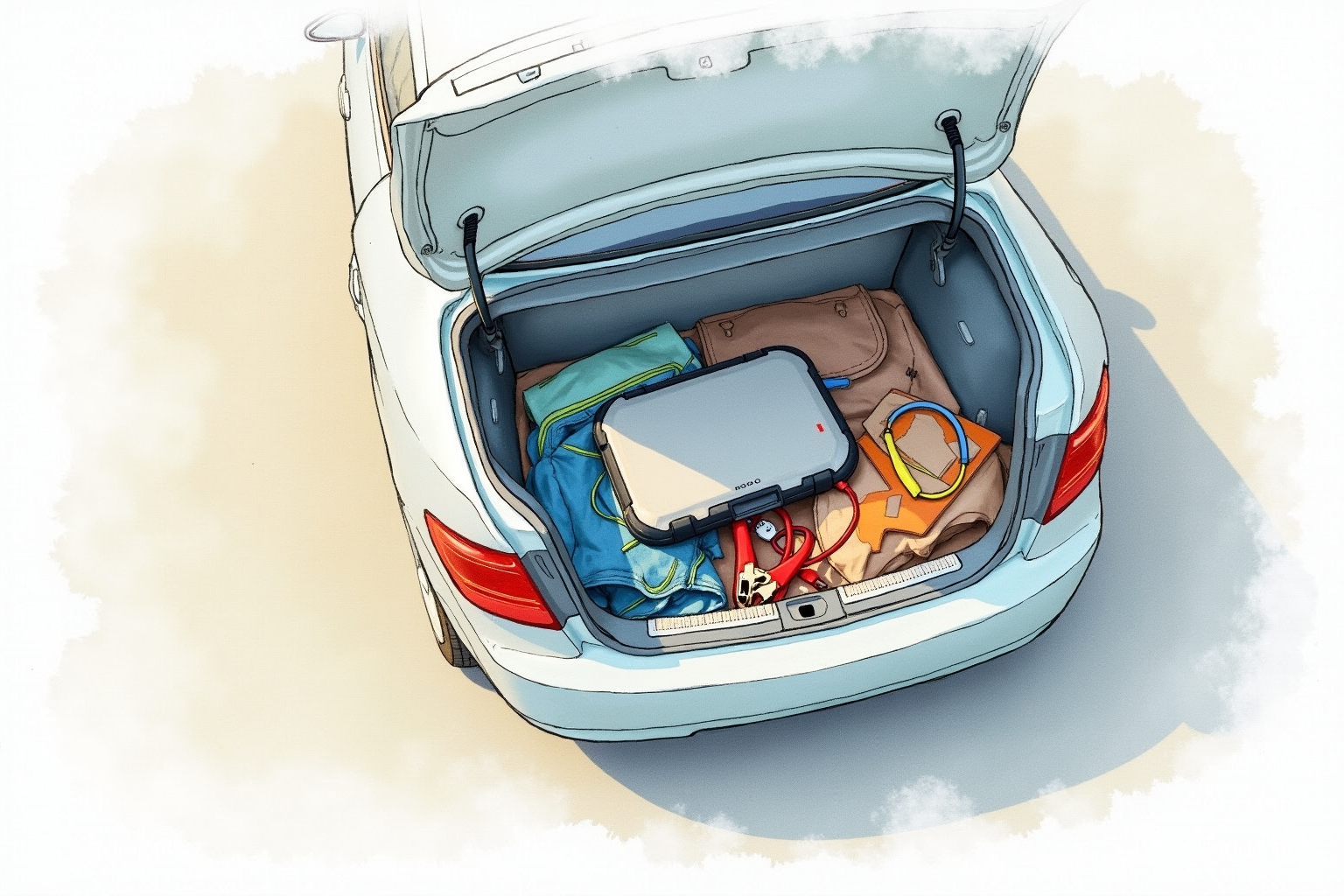
NOCO Boost Plus GB40 1000A Lithium Jump Starter
Price · $100-130
+ Pros
- · Starts vehicles up to 6L gas, 3L diesel
- · Reverse polarity protection prevents damage
- · Built-in LED flashlight with 7 modes
- · USB-A output for charging phones/devices
− Cons
- · Premium price for budget alternatives
- · Requires periodic charging (every 6 months)
- · Lithium pack performance degrades in extreme cold below 0°F
Price, availability, and ratings can change; verify details on the retailer page before buying.
Per Wirecutter long-term testing, NOCO Boost Plus GB40 is the consistent top recommendation. Reliable performance for most passenger vehicles, multi-function design (jump start + USB power + flashlight), safety features prevent user error damage.
For most car owners, this is the right purchase. The $100-130 cost is justified by 10+ year longevity and avoided tow truck calls.
Budget alternative: GOOLOO MAX25
GOOLOO MAX25 4000A Jump Starter Pack
Price · $90-130
+ Pros
- · Higher peak current (4000A) than NOCO GB40
- · Larger battery capacity (24000mAh)
- · QC3.0 fast USB charging
- · Three USB outputs
− Cons
- · Bulkier than NOCO Boost Plus
- · Less polished build quality
- · Newer brand with shorter track record
Price, availability, and ratings can change; verify details on the retailer page before buying.
GOOLOO and similar challenger brands (TACKLIFE, HULKMAN, AVAPOW) offer compelling specs at lower prices. GOOLOO MAX25 specifically has strong reviews for reliability.
For users who prioritize specs and value, GOOLOO is the alternative. NOCO has longer track record and better customer service.
Premium option: NOCO Boost Pro GB150
NOCO Boost Pro GB150 3000A Jump Starter
Price · $200-280
+ Pros
- · Starts up to 8L gas, 6L diesel engines
- · Handles RVs, boats, large trucks
- · More durable construction
- · Larger battery for multiple jumps per charge
− Cons
- · High price for typical passenger car use
- · Heavier (5+ lbs vs 2.4 lbs GB40)
- · Overkill for most users
Price, availability, and ratings can change; verify details on the retailer page before buying.
NOCO Boost Pro GB150 is for users with larger vehicles (RV, boat, large truck) or commercial fleet use. For typical passenger car owners, the GB40 is sufficient.
Traditional jumper cables
For users who want reliable, no-battery-required option:
Cartman Premium Jumper Cables 4 AWG 20 Ft
Price · $30-50
+ Pros
- · 4 AWG heavy gauge for high current
- · 20 feet length reaches between vehicles
- · Tangle-free design with carrying case
- · Lifetime warranty from quality brand
− Cons
- · Requires second vehicle to use
- · Improper connection can spark/damage
- · Bulkier to store than jump pack
Price, availability, and ratings can change; verify details on the retailer page before buying.
Quality jumper cables ($30-50) are reliable backup. No battery to drain over time, works after years of storage, lasts 20+ years.
The downside: requires willing helper with running vehicle. In remote areas or solo emergencies, jump pack is more practical.
Combined approach (recommended)
Best practice: own both. Cables stored in trunk for backup, jump pack for primary use.
Reasons:
Cables don’t fail: stored cables work 10+ years later. Jump pack batteries can fail or be dead when needed.
Cables don’t need maintenance: jump pack needs charging every 6 months.
Cables faster in some scenarios: with helper, cables are quicker than waiting for jump pack to engage protection circuits.
Redundancy: if jump pack fails (rare but happens), cables save the day.
Combined cost: $130-180. One-time purchase serves for decades.
Jump pack safety features
Modern jump packs include several safety features that prevent damage from user error:
Reverse polarity protection: jump pack detects if clamps are connected backwards. Won’t start, alerts user. Prevents major electrical damage that improper jumping can cause.
Short circuit protection: clamps touching each other don’t damage pack.
Spark-free clamps: clamps don’t carry current until properly connected to battery terminals. No sparks from accidental contact.
Low-voltage cutoff: jump pack stops trying to start vehicle if voltage stays low (indicating engine won’t start or further attempt will damage pack).
Temperature monitoring: pack disables if internal temperature exceeds safe range.
Quality brands (NOCO, GOOLOO, TACKLIFE) include all these features. Avoid budget brands that lack safety protection — can damage your vehicle’s electrical system.
Storage and maintenance
Charge level monitoring: check jump pack charge every 6 months. Most have LED indicators. Top off when below 50%.
Storage temperature: room temperature ideal (50-70°F). Hot car trunks in summer reduce lithium battery life.
Avoid full discharge: don’t store at 0% charge. Damages lithium chemistry permanently.
Yearly test: test jump pack on healthy battery yearly to confirm it works. Don’t wait until emergency to discover dead jump pack.
Replacement timeline: lithium-ion packs last 5-7 years with proper care. Plan to replace before failure.
For jumper cables: occasionally inspect clamp condition, ensure cables not damaged. Cables typically last 20+ years.
Proper jumpstart procedure
For jump pack (NOCO and similar):
- Park dead-battery vehicle in safe location with engine off
- Connect red clamp to positive (+) battery terminal
- Connect black clamp to ground (engine block bolt, away from battery)
- Press jump pack power button
- Wait for green ready light
- Start dead vehicle (may take 1-2 attempts)
- Once running, disconnect clamps in reverse order: black first, then red
- Let vehicle run 20-30 minutes to recharge battery
- Charge jump pack after use
For jumper cables (between two vehicles):
- Park helper vehicle close enough for cables to reach
- Both vehicles off, parking brake on
- Connect red clamp to dead battery positive
- Connect other red clamp to helper battery positive
- Connect black clamp to helper battery negative
- Connect other black clamp to engine block ground on dead vehicle (not battery negative)
- Start helper vehicle, let run 2-3 minutes
- Start dead vehicle
- Disconnect in reverse order: ground, negative, positive, positive
The grounding location matters — connecting black clamp to dead battery negative can spark hydrogen gas from battery.
Bottom line
For most car owners: NOCO Boost Plus GB40 ($100-130) as primary jump tool, supplemented by quality cables ($30-50) as backup. Total ~$150 covers most jumpstart scenarios for 10+ years.
For drivers in remote areas or solo travelers: jump pack is essential. Don’t rely solely on cables requiring helper.
For larger vehicles (RV, large truck): NOCO Boost Pro GB150 for sufficient starting power.
For tight budget: quality cables alone (Cartman 4 AWG) at $30-50 is reasonable starting point. Add jump pack later when budget allows.
Check jump pack charge every 6 months. Replace at 5-7 year mark to prevent failure when needed.
For complementary reading, see cordless car vacuum tested, windshield wiper replacement guide, and the car maintenance category.