Dense Fog Driving: A Visibility, Headlight, and Pull-Over Plan
Use a practical dense-fog plan for speed, low beams, following distance, lane position, and deciding when and where to stop safely.
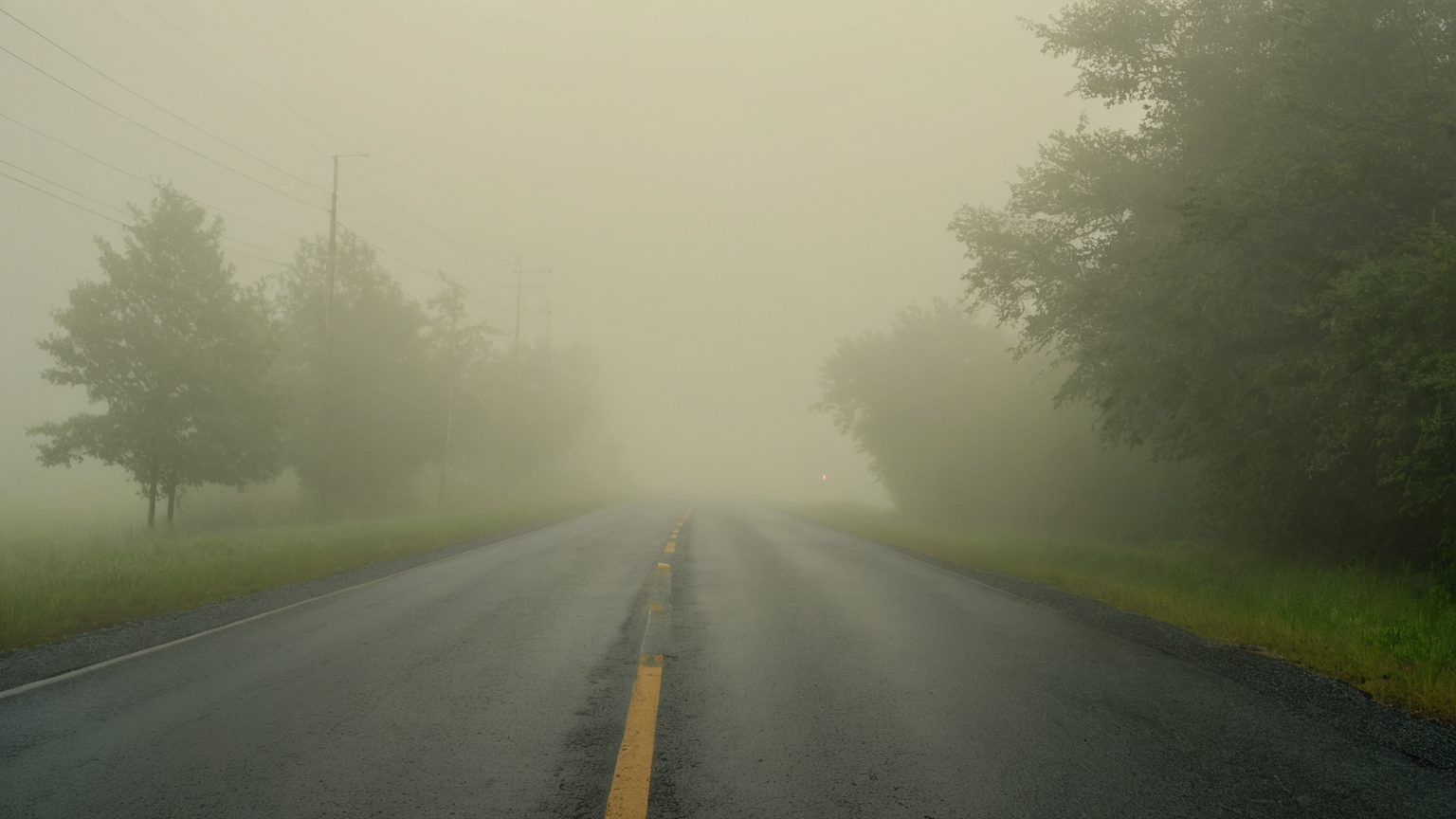
Dense fog can turn an ordinary commute into a moving visibility test. The pavement may be dry, the car may have full mechanical grip, and yet the driver cannot see a stopped queue, a pedestrian, a curve, or debris soon enough to respond. That mismatch matters: drivers often choose speed from how the road feels rather than from how far ahead they can actually see.
The safe response is not a magic fog speed. It is a chain of decisions: check whether the trip can wait, make the vehicle visible without creating glare, slow before the view collapses, open a much larger gap, avoid unnecessary lane changes, and leave the roadway at a genuinely protected place if the visible distance becomes shorter than the distance needed to stop. The National Weather Service calls dense fog hazardous to drivers and notes that restricted visibility contributes to travel accidents (NWS fog safety).
The 30-second dense-fog decision
Before moving, use this order:
- Check the forecast and the route. Look for a Dense Fog Advisory, nearby crashes, closures, school delays, and live road cameras. Fog can be shallow and local; a camera along the actual route is more useful than a citywide weather icon.
- Set a no-go trigger. Delay when visibility is already extremely poor, the route has fast traffic or narrow shoulders, the windshield will not stay clear, the lights are defective, or fatigue makes sustained scanning difficult.
- Prepare the view. Clean the inside and outside of the windshield, clear every lamp and camera, set the defroster, and know the low-beam control before entering fog.
- Choose a lower-complexity route. A slightly longer road with lower speeds, fewer merges, and safe stopping places may be preferable to a freeway with limited sight distance.
- Remove urgency. Tell others that arrival may be late. A schedule is never evidence that the road is visible enough.
The Federal Highway Administration says fog, heavy precipitation, blowing snow, dust, and smoke reduce visibility, and that low visibility increases speed variance among vehicles—one reason traffic can become unstable even when no one vehicle seems especially fast (FHWA low visibility). Your plan should reduce both absolute speed and surprise.
Headlights: low beams, not more glare
Use low-beam headlights. High beams aim more light forward and upward, where suspended water droplets scatter it back toward the driver. The result can be a bright white curtain and less usable contrast. The California Driver’s Handbook explicitly advises low beams in heavy fog or smoke and warns that high beams reflect back and cause glare (California DMV).
Fog lamps may improve near-road illumination on some vehicles, but they do not extend the safe stopping distance, make lane markings reliable, or justify more speed. Use them only with the lighting combination permitted by local law and described in the owner’s manual. Never drive with only parking lights; they are not designed to illuminate the road or provide the same conspicuity as required headlights.
Daytime running lights can be another trap. On some vehicles they illuminate the front while leaving the rear lamps dark. Select the actual low-beam setting and confirm the instrument indicator. Automatic headlights may not interpret bright daytime fog as darkness, so do not assume “Auto” has switched everything on.
Interior light also matters. Dim an overly bright instrument panel enough to preserve contrast outside, but keep essential gauges readable. Do not stare at the hood or the brightest fog directly ahead. Scan the lane edges, reflectors, vehicles, mirrors, and the farthest clear path without fixating on one point.
A visibility-to-stop calculation
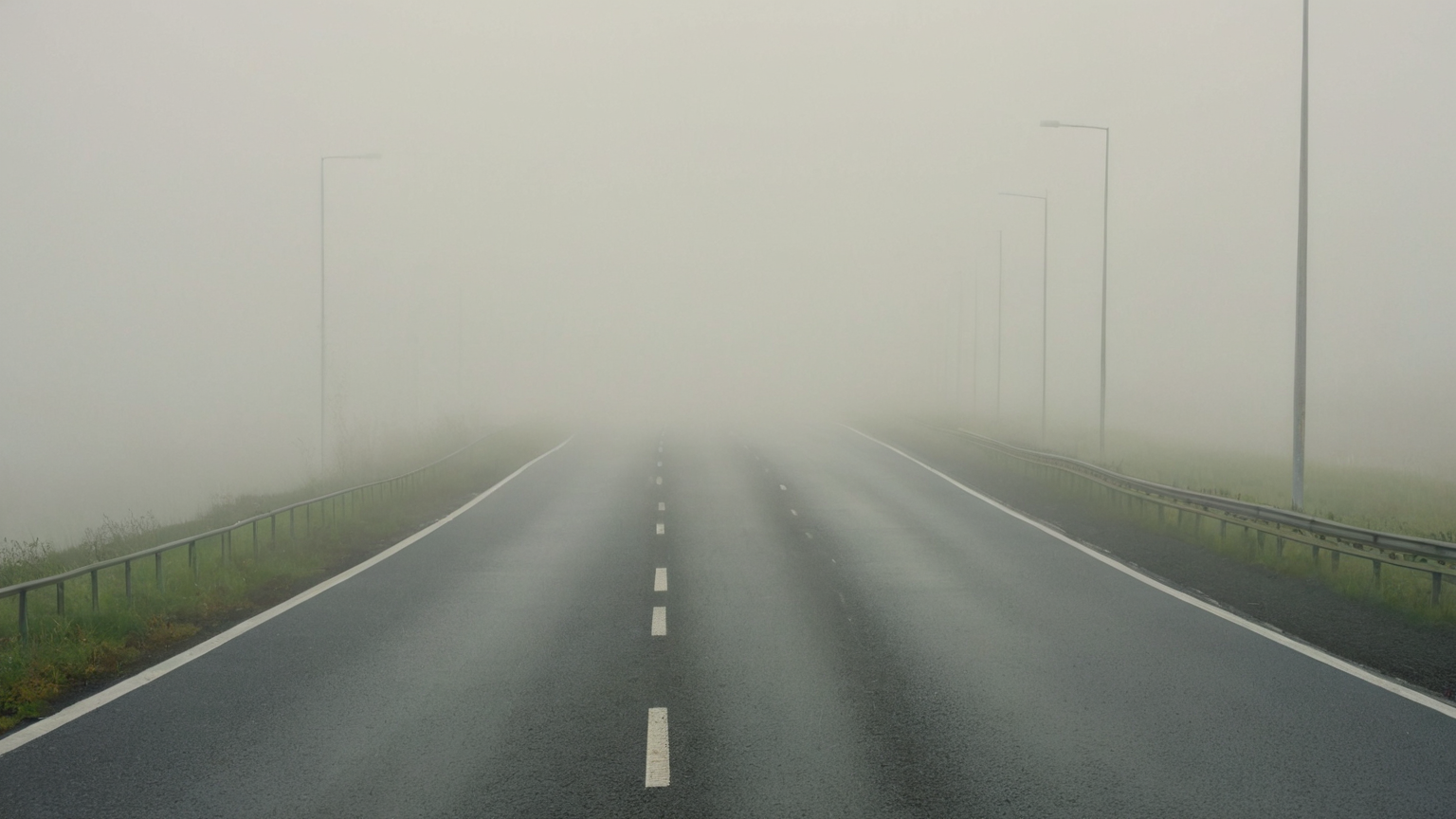
A driver needs distance to perceive a hazard, react, and brake. The calculation below is a dry, level-road illustration, not a fog speed limit or a prediction for your car. Assume a 1.5-second perception-and-response interval and constant braking at 0.60 g after pedal application:
- reaction distance = speed in feet per second × 1.5 seconds
- idealized braking distance = speed² ÷ (2 × 0.60 × 32.2 ft/s²)
- benchmark total = reaction distance + braking distance
| Assumed speed | Reaction distance | Dry benchmark braking | Dry benchmark total |
|---|---|---|---|
| 20 mph | 44 ft | 22 ft | 66 ft |
| 30 mph | 66 ft | 50 ft | 116 ft |
| 40 mph | 88 ft | 89 ft | 177 ft |
| 50 mph | 110 ft | 139 ft | 249 ft |
| 60 mph | 132 ft | 200 ft | 332 ft |
At 50 mph, the benchmark is approximately 249 feet. If the reliably clear distance is only 200 feet, the example leaves a 49-foot deficit before adding margin:
200 − 249 = −49 feet
Reducing the example to 40 mph changes the calculated total to 177 feet, but the remaining 23 feet is not a safety guarantee. It may disappear because of wet pavement, downhill grade, worn tires, delayed recognition, brake condition, a heavy load, or a stopped vehicle without lights. The California handbook’s core rule is more useful than any chart: be able to stop within the space visible ahead. If you cannot create substantial margin, continue slowing and seek a safe place off the roadway.
The Federal Motor Carrier Safety Administration’s professional-driver material emphasizes that speed must be reduced for conditions such as fog, rain, snow, curves, and limited sight distance (FMCSA conditions guidance). Commercial stopping distances differ from passenger cars, but the decision principle transfers: the posted limit describes an upper legal boundary under appropriate conditions, not a promise that the road ahead is visible.
Following distance: preserve the view and an escape path
Do not use a fixed three-second gap as a universal fog prescription. Increase separation until you can see lane references, detect a slowdown, and make every speed change progressively. If the lead vehicle’s taillights are the only thing you can see, you may be following its mistakes rather than navigating the road.
Avoid “locking on” to the car ahead. Its driver may be exceeding visible stopping distance, drift across a line, or brake for a hazard you cannot see. Keep independent lane references. If another vehicle cuts into your gap, lift smoothly and rebuild it instead of braking sharply.
Stay out of clusters. Driving side by side leaves less space if one vehicle wanders. Avoid passing unless it is necessary and clearly legal; a lane change can put you into a faster stream, hide a smaller road user, and remove the lane edge you were using as a reference. New York DMV guidance for special conditions advises reduced speed, low beams, increased following distance, and attention to road-edge markings in fog (New York DMV).
Do not use cruise control in dense fog. Direct control makes it easier to ease off early when visibility changes. Keep both hands available, silence nonessential notifications, and postpone eating, navigation entry, and calls. If a route instruction arrives late, miss the turn rather than making an abrupt maneuver.
Lane position, curves, intersections, and ramps
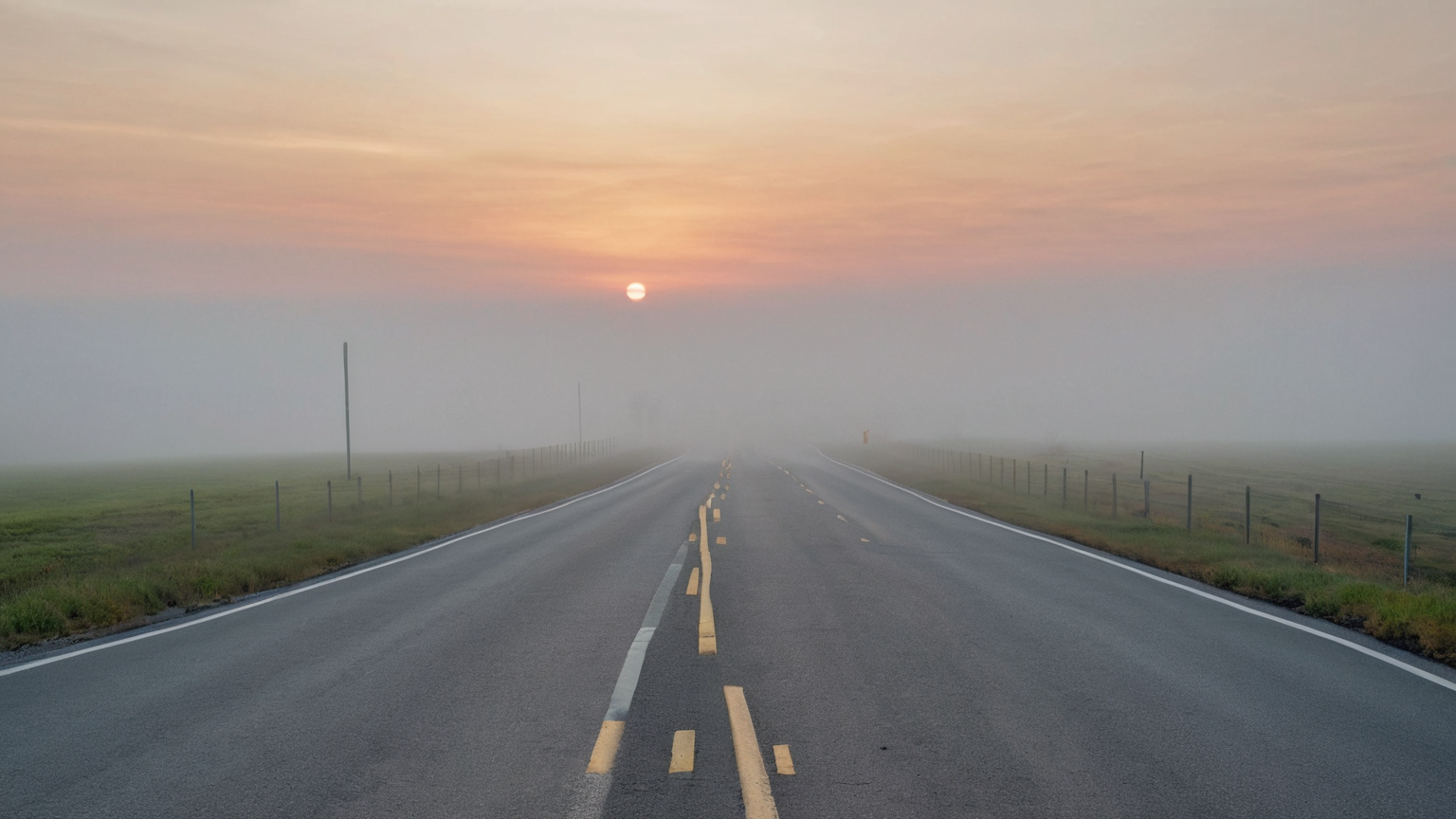
Use the right edge line and nearby lane reflectors as references without staring at them. Do not hug the centerline: an oncoming vehicle may also be displaced. Expect visibility to fall suddenly in low ground, near rivers, after a crest, beside irrigated fields, and at the edge of a fog bank.
| Road feature | Main fog risk | Lower-risk response |
|---|---|---|
| Hill crest | A stopped queue is hidden beyond the top | Reduce speed before the crest; avoid passing |
| Curve | Headlights and sight line point away from the path | Enter slower and hold a smooth lane position |
| Freeway ramp | Merge speed and traffic speed may differ sharply | Use the full acceleration lane only when the merge is visible; do not force entry |
| Unsignalized intersection | Cross traffic may appear with little warning | Cover the brake, scan repeatedly, and do not rely on hearing alone |
| Railroad crossing | A train or queue can be obscured | Obey signals and markings; never enter without room to clear the tracks |
| Work zone | Temporary lines and workers are harder to identify | Slow early, follow temporary controls, and avoid last-second lane changes |
North Carolina DOT’s driving-safety hub stresses adjusting to road and weather conditions and preparing before travel (NCDOT driving safety). In fog, that adjustment should happen before a curve, ramp, or queue—not after its first visible clues.
Listen, but do not treat an open window as a sensor that proves the way is clear. Tire noise, horns, and crossing bells can provide clues, while wind and other traffic can mask them. Keep full visual and legal responsibility for the path.
Windshield, wipers, and defogging
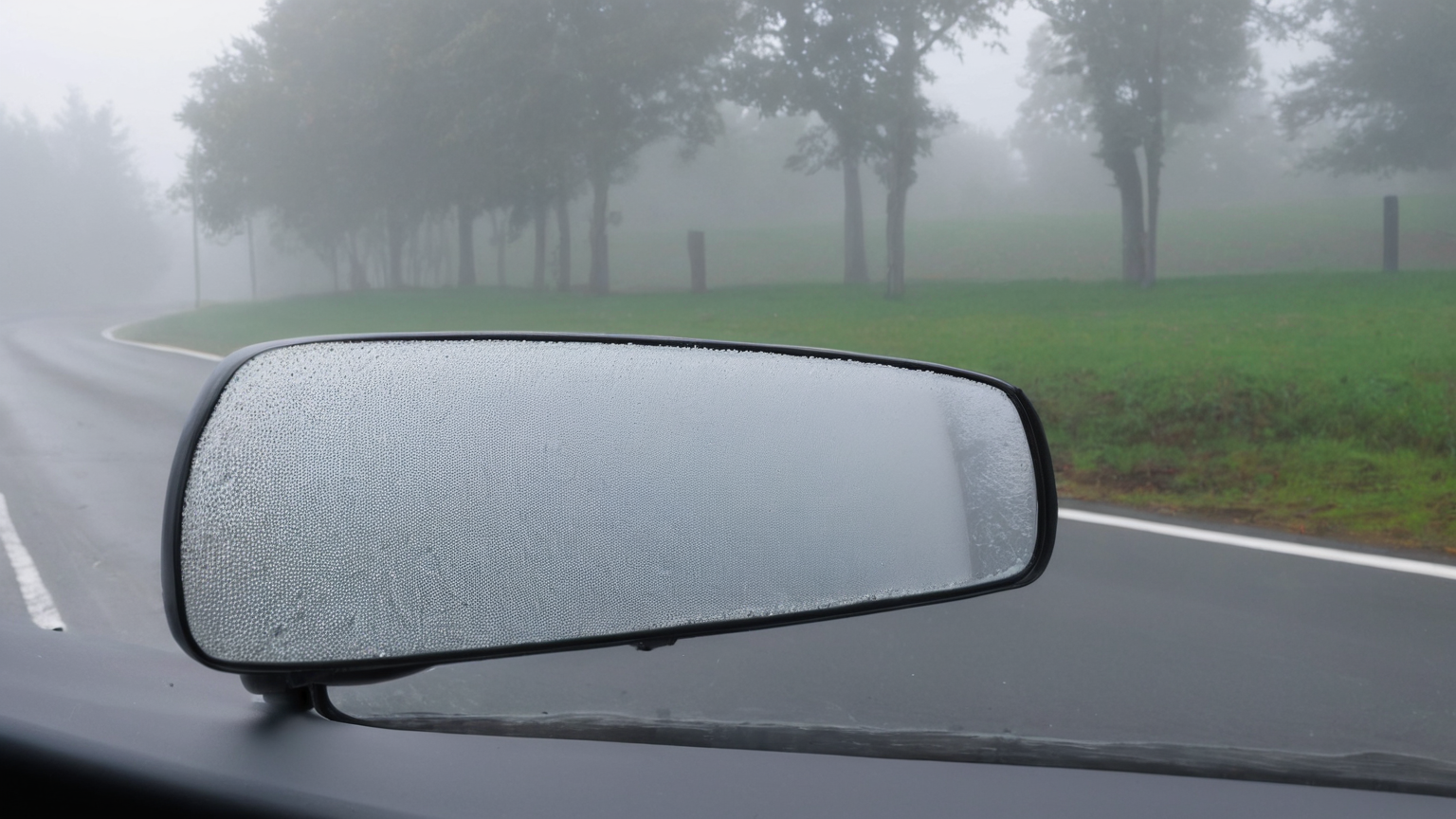
Fog outside and condensation inside can occur together. Use the climate-control defog or defrost mode, adjust temperature and airflow, and use air conditioning if the owner’s manual recommends it for dehumidification. Avoid wiping the inside glass with a hand; it leaves oils and streaks that bloom around lights.
Run wipers when droplets collect, even if there is no obvious rain. Replace blades that chatter, skip, or leave a film; the windshield-wiper replacement guide explains how to inspect size and attachment without assuming every blade fits every arm. Keep washer fluid appropriate for the expected temperature.
If the windshield cannot remain clear, the vehicle is not ready to continue. Do not lean forward to peer through one small patch. Move to a protected stopping place while enough visibility remains to reach it safely.
When and where to pull over
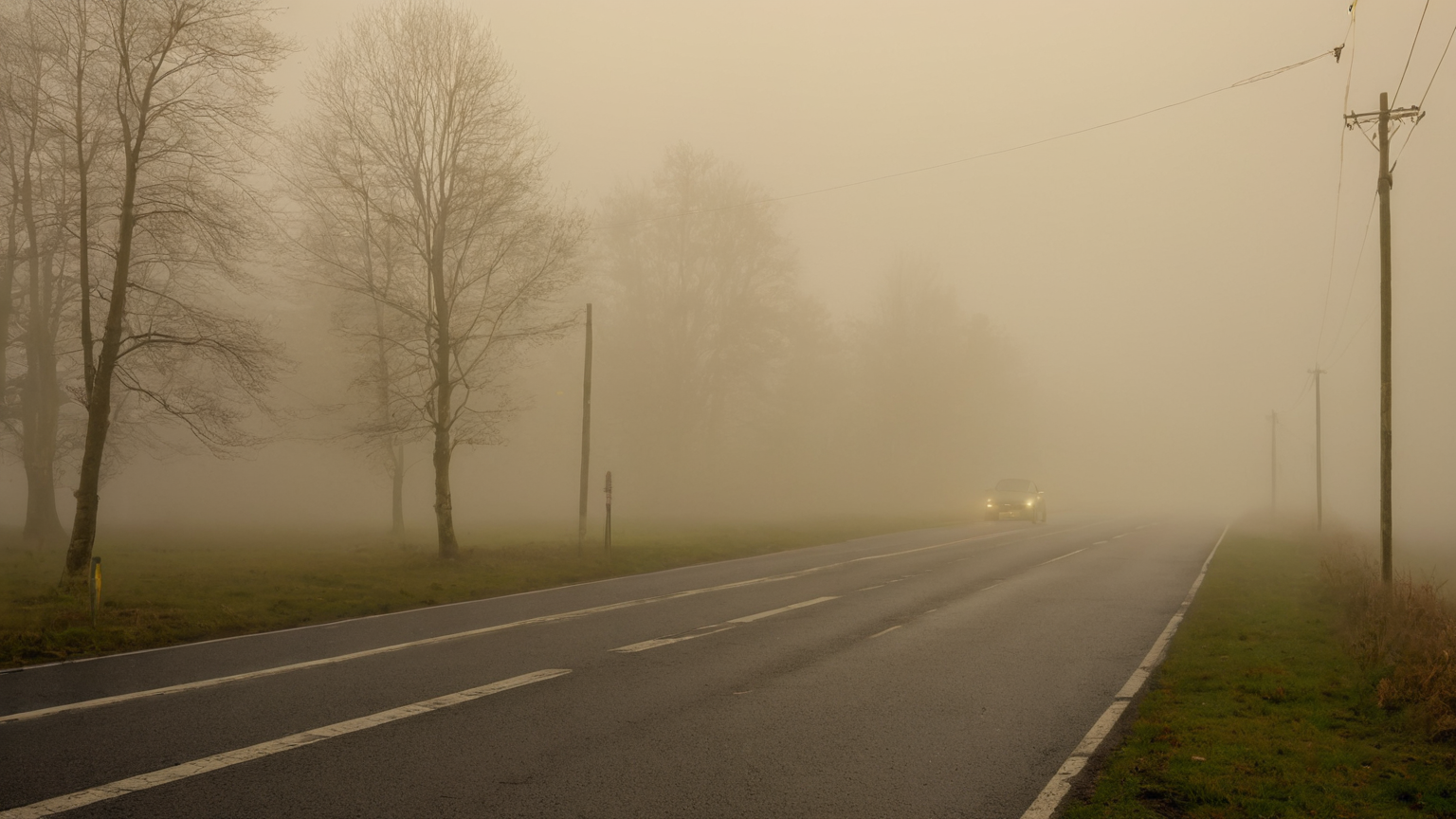
“Pull over” is incomplete advice because a narrow shoulder can be struck by a driver who mistakes taillights for moving traffic. Prefer, in order, an exit, rest area, parking lot, service station, or paved turnout physically separated from the travel lanes. Make the decision early enough that you do not need a sudden lane change.
If a safe destination is reachable, signal early, decelerate progressively, and continue fully out of traffic. Once parked, select Park, set the parking brake, and remain belted if there is any exposure to moving vehicles. Whether to use hazard flashers while moving varies by state; follow local law. When stationary in a lawful safe place, use lights as appropriate to make the vehicle conspicuous without implying that a shoulder is a travel lane.
If an emergency forces a shoulder stop, move as far beyond the edge line as the surface safely permits, avoid stopping just beyond a crest or curve, and call emergency services for an immediate collision hazard. Do not stand next to the traffic side of the vehicle. Follow dispatcher instructions. Florida’s highway-safety agency summarizes the basic visibility message as “When Visibility is Low, Drive Slow” and includes smoke, fog, and heavy rain among the hazards (FLHSMV). Slowing is necessary, but safe separation from the travel lane is what makes a stop protective.
Never stop in a live lane merely because the fog is thick. If traffic has already stopped ahead, activate warning lights as local law allows, keep space from the vehicle ahead, monitor mirrors, and avoid exiting into traffic. Call 911 if a crash or blockage creates immediate danger.
Vehicle and trip checklist
Before fog season or an early-morning trip:
- Verify low beams, taillights, brake lights, turn signals, and hazard lamps.
- Clean lamp lenses, windows, mirrors, cameras, and sensors.
- Test wipers, washer spray, heater, air conditioning, and defrosters.
- Set mirrors and navigation before moving.
- Check tire pressure against the door-jamb placard and inspect tread and damage.
- Carry a charged phone, reflective vest, flashlight, water, needed medicines, and warm layers.
- Save road-agency and weather links, and tell someone the route for remote travel.
- Maintain fuel or charge margin for a delay or detour.
Ready.gov recommends keeping emergency supplies in the vehicle and planning for weather, breakdowns, and delays (Ready.gov car safety). The site’s emergency roadside kit guide can help organize that equipment. The kit is backup, not permission to enter a forecast dense-fog corridor.
Fog can also leave pavement wet. If standing water and tire spray become the dominant hazards, use the hydroplaning recovery plan. If temperatures are near freezing, remember that a wet-looking bridge may also be icy; the first-freeze black-ice plan covers that separate traction problem.
Limits and stop conditions
This article cannot observe current visibility, traffic, closures, your vehicle, or local law. The benchmark table assumes a dry, level road and idealized constant deceleration; it excludes brake lag, grade, wet leaves, ice, standing water, tire variation, load, and human uncertainty. It must not be used to select a “safe fog speed.”
Delay or stop at a protected location when you cannot maintain a clear stopping margin, lane lines disappear, the windshield will not stay clear, warning lights or wipers fail, traffic speed differences become severe, authorities close the road, or fatigue and anxiety prevent steady control. Police, road crews, variable-message signs, and emergency instructions supersede general guidance.
Smoke, dust, snow, and heavy rain can also reduce visibility, but each adds different respiratory, traction, fire, or flood hazards. Do not enter wildfire smoke or a flooded road based on fog techniques. Turn around, reroute, or follow evacuation officials.
Frequently asked questions
Should I use high beams in dense fog?
No. Low beams generally produce less reflected glare. Use fog lamps only as allowed by local law and the owner’s manual, and never substitute parking lights for required headlights.
Can I follow taillights to stay in the lane?
Use a lead vehicle only as one clue, not as your guide. Keep your own lane references and a much larger gap. The other driver may brake suddenly, leave the road, or be driving beyond the distance visible ahead.
How fast should I drive with 200 feet of visibility?
There is no universal answer. Under this article’s dry illustration, 50 mph needs about 249 feet for reaction plus braking, already more than 200 feet. Real conditions require additional margin. Slow further or leave the roadway safely if you cannot stop within the reliably clear path.
Should hazard lights be on while I am moving?
Rules differ by jurisdiction. They can also obscure turn-signal intent on some vehicles. Follow local law and the owner’s manual; do not let flashers replace low beams, speed reduction, and following distance.
Is the shoulder a safe place to wait?
Not automatically. A narrow shoulder can remain inside the path of an impaired or confused driver. Prefer an exit, lot, rest area, or protected turnout. If an emergency makes shoulder use unavoidable, get fully beyond the edge line, avoid curves and crests, remain protected, and contact emergency services for immediate danger.
Bottom line
Dense fog is a sight-distance problem before it is a traction problem. Use low beams, slow before visibility collapses, create a gap large enough for smooth decisions, keep independent lane references, and choose a protected place to wait before the roadway disappears. If you cannot see enough road to stop with margin, the correct driving technique is to stop driving—after leaving the travel lane safely.